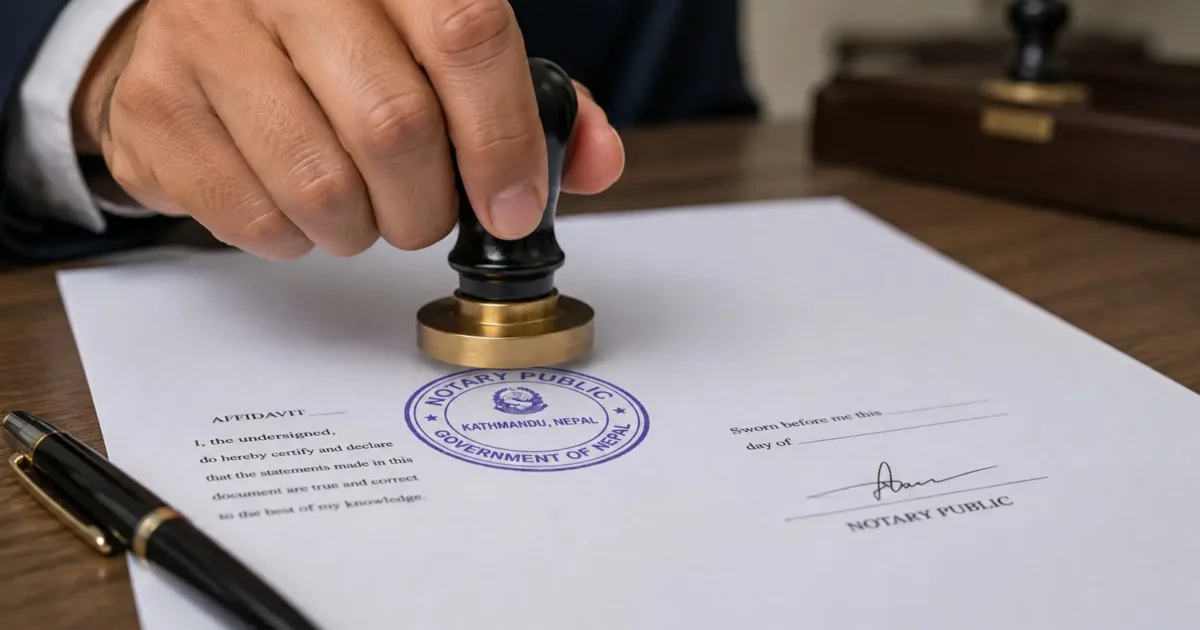
Quick Summary — Document Legalization in Nepal (नेपालमा डकुमेन्ट लिगलाईजेशन):
In Nepal, international document legalization begins with a licensed Notary Public certifying a true copy of original documents (सक्कल बमोजिम नक्कल प्रमाणित). Where required by foreign authorities, documents are legalized by the Ministry of Foreign Affairs (MoFA, Department of Consular Services). Crucially, the applicant or their close relative must physically present the original documents in person at the Ministry. Furthermore, Nepal does NOT issue Apostilles because Nepal is not a signatory to the 1961 Hague Apostille Convention. Documents requiring international validation follow the traditional diplomatic chain: Notary Certification → MoFA Legalization → Destination Embassy Attestation.
📜 नेपालमा डकुमेन्ट लिगलाईजेशन सम्बन्धी आधिकारिक कानुनी नियम
“नेपालमा डकुमेन्ट लिगलाईजेशन को हकमा नोटरी पब्लिकबाट सक्कल बमोजिम नक्कल प्रमाणित हुन्छ । कुनैकुनै देशमा परराष्ट मन्त्रालयबाट लिगलाईजेश माग गर्दछ । त्यसको लागि सम्वन्धित व्यक्ति वा निजको नातेदार आफै मन्त्रालयमा सक्कल कागजात साथ उपस्थित भएमा मन्त्रालयबाट लिगलाईजेशन हुन्छ । नेपालबाट अपस्टिल जारी हुँदैन किनभने नेपाल सन १९६१ को हेग अपस्टिल कन्भेन्सनको सदस्य होइन ।”
- १. नोटरी पब्लिकको भूमिका: सक्कल कागजात परीक्षण गरी ‘सक्कल बमोजिम नक्कल’ (Certified True Copy) प्रमाणित गर्ने र आधिकारिक कानुनी अंग्रेजी अनुवाद गर्ने।
- २. परराष्ट्र मन्त्रालयमा अनिवार्य भौतिक उपस्थिति: कन्सुलर सेवा विभागबाट प्रमाणीकरण गर्दा सम्बन्धित व्यक्ति वा निजको नजिकको नातेदार आफै सक्कल कागजात लिएर उपस्थित हुनुपर्ने।
- ३. नेपालबाट अपस्टिल जारी नहुने: नेपाल हेग अपस्टिल कन्भेन्सनको पक्ष राष्ट्र नभएकाले परम्परागत कन्सुलर प्रमाणीकरण (Diplomatic Legalization) बाहेक अपस्टिल जारी गर्न मिल्दैन।
If you are applying to study abroad, relocating for employment, registering an overseas marriage, settling foreign inheritance, or submitting legal paperwork to a foreign government, your Nepali documents will almost certainly require document legalization (डकुमेन्ट लिगलाईजेशन).
However, document legalization in Nepal is often surrounded by confusion. Internet forums frequently publish outdated or incorrect information claiming that “Nepal joined the Hague Apostille Convention in 2017,” or that third-party agents can obtain MoFA legalization without personal attendance. This comprehensive legal guide explains the exact statutory procedures, the mandatory in-person presence rule at the Ministry of Foreign Affairs, and how to successfully prepare your documents for international use.
What Is Document Legalization in Nepal?
Document legalization is the official multi-tiered verification process by which a public or private document executed in Nepal is certified so that authorities in a foreign country will recognize it as authentic. A foreign court, university registrar, or immigration department cannot independently verify a Nepali ward office stamp, a local school certificate, or a Nepali citizenship card. Legalization creates an unbroken chain of official authentication where each authority verifies the signature and seal of the preceding one.
For Nepal, this legal chain operates as follows:
- Notary Public Verification: Examination of the original document, certification of a true copy (सक्कल बमोजिम नक्कल प्रमाणित), and/or official translation into English under the Notary Public Act, 2063.
- Ministry of Foreign Affairs (MoFA) Legalization: Authentication of the Notary Public’s seal and signature by the Department of Consular Services (कन्सुलर सेवा विभाग), Tripureshwor, Kathmandu.
- Destination Country Embassy Attestation (if required): Final attestation by the foreign embassy in Kathmandu confirming MoFA’s consular seal for use in non-Hague or strict attestation jurisdictions.
Step 1: Notary Public True Copy Certification (सक्कल बमोजिम नक्कल)
In Nepal, document legalization always begins at the office of a licensed Notary Public. Under the Notary Public Act, 2063 (२०६३) and the Notary Public Rules, 2063, a Notary Public is statutory authorized to perform three core legal functions:
- Certification of True Copies (सक्कल बमोजिम नक्कल प्रमाणित): The notary physically examines the original document, compares it against the photocopy, verifies that it is an exact reproduction without alteration, and stamps it as a certified true copy.
- Certified Legal Translation (कानुनी अनुवाद प्रमाणीकरण): Translating Nepali official documents (citizenship certificates, ward birth and marriage certificates, relationship certificates, police clearance, land ownership records) into English with the notary translator’s official seal and declaration.
- Witnessing Signatures & Affidavits (दस्तखत तथा सपथ प्रमाणीकरण): Verifying personal identity, witnessing signatures on powers of attorney, affidavits, deeds, and commercial agreements.
Neither the Ministry of Foreign Affairs nor foreign embassies will legalize raw photocopies. They require an initial certification from a registered Notary Public whose signature and seal specimen are actively on file with the Notary Public Council of Nepal.
Step 2: Ministry of Foreign Affairs (MoFA) & In-Person Presence Rule
Once your documents are certified by a licensed Notary Public, documents destined for jurisdictions that demand government-to-government verification must be presented to the Ministry of Foreign Affairs (MoFA), Department of Consular Services (कन्सुलर सेवा विभाग) located at Tripureshwor, Kathmandu.
⚠️ Mandatory In-Person Presence Rule at MoFA:
Under current MoFA consular regulations, document legalization is not handed to random third-party intermediaries without authorization. The concerned applicant or their close relative must physically present the original documents in person at the Department of Consular Services. If a close relative attends, they must provide verifiable proof of kinship (such as a ward-issued relationship verification certificate or original citizenship certificates showing parental lineage).
What MoFA Does: The Department of Consular Services verifies the Notary Public’s registration and specimen signature against their official database, inspects the applicant’s original records, and affixes the official Nepal Government consular legalization sticker and seal.
Why Nepal Does NOT Issue Hague Apostilles (1961 Convention Explained)
One of the most persistent misunderstandings among students and visa applicants is asking for an “Apostille certificate from Nepal.”
The Legal Fact: Nepal does NOT issue Apostilles because Nepal is not a signatory to the 1961 Hague Apostille Convention.
The Hague Convention of 5 October 1961 Abolishing the Requirement of Legalisation for Foreign Public Documents (the Apostille Convention) is a multilateral treaty designed to replace complex embassy legalization with a single standardized stamp called an Apostille. However, this treaty only operates between contracting member states.
| Legal Question | Legal Reality for Nepal |
|---|---|
| Is Nepal a member of the 1961 Hague Apostille Convention? | No. Nepal has never ratified or acceded to the 1961 Hague Convention. |
| Can the Ministry of Foreign Affairs (MoFA) issue an Apostille? | No. MoFA issues consular legalization, not Hague Apostille certificates. |
| Can an Indian notary or Indian authority apostille Nepali papers? | No. Under international law, a country can only apostille documents originating within its own jurisdiction. |
| What is the recognized equivalent from Nepal? | The Diplomatic Legalization Chain: Notary Certified True Copy/Translation → MoFA Consular Legalization → Target Embassy Attestation. |
What If a Foreign Institution Asks for an “Apostille” from Nepal?
Universities in Germany, Italy, Spain, France, and various US/UK employers often send automated checklists that state: “Please provide your degree certificate with an Apostille stamp.”
When you encounter this requirement, follow this proven procedure:
- Inform the Authority: Clarify that Nepal is not a signatory to the 1961 Hague Apostille Convention and that government authorities in Nepal do not have the legal power to issue apostilles.
- Provide the Diplomatic Legalization Chain: Explain that Nepal’s official legal equivalent is a Notary Public certified true copy (सक्कल बमोजिम नक्कल प्रमाणित) and translation, accompanied by Ministry of Foreign Affairs (MoFA) consular legalization.
- Submit Embassy Attestation If Demanded: If the foreign institution still requires an additional sovereign guarantee, have the document attested by their country’s embassy or consulate in Kathmandu. Almost all foreign universities and immigration departments readily accept this complete diplomatic legalization.
Step 3: Foreign Embassy Attestation in Kathmandu
Whether you need embassy attestation after MoFA depends entirely on your destination country and the specific purpose of the document:
- Gulf Countries (UAE, Qatar, Saudi Arabia, Kuwait, Bahrain, Oman): Mandatory full three-step chain. Documents must be attested by the target embassy in Kathmandu before work permits or family residency visas are granted.
- European & Schengen Countries (Germany, Italy, Poland, France): Academic and civil documents typically require Notary verification and MoFA legalization. Certain visa pathways (such as German family reunion or Italian student declarations of value) may require a final embassy verification appointment.
- United States, United Kingdom, Canada, Australia: Most immigration authorities (USCIS, UK Home Office, Australian Department of Home Affairs, IRCC) accept certified English translations accompanied by a Notary Public certified true copy without requiring embassy legalization. However, for court proceedings or property transactions, MoFA legalization is strongly recommended.
Documents That Commonly Require Legalization
At Hamro Notary, we prepare all categories of personal, academic, and business records for international legalization:
- Civil Vital Statistics: Birth certificates, marriage certificates, relationship verification certificates (नाता प्रमाणित), single status / unmarried certificates, and death certificates issued by local ward offices.
- Academic Credentials: Secondary Education Examination (SEE), +2 / NEB certificates, Bachelor’s and Master’s degree certificates, semester marksheets, and university transcripts.
- Police Clearance Records: Nepal Police Clearance Certificates (PCC) issued for visa and migration purposes.
- Legal Affidavits & Powers of Attorney: General and Special Powers of Attorney (वारिसनामा), sponsorship declarations, name discrepancy affidavits, and court judgments.
- Corporate & Business Records: Company registration certificates (CRO), Memorandum & Articles of Association (MOA/AOA), Board Resolutions, PAN/VAT certificates, and CA audit reports.
Checklist: What to Bring for Legalization
To avoid rejection or repeated visits between government offices, ensure you have the following items ready:
- Original Documents (सक्कल कागजात): You must have the original physical certificates. Notaries and MoFA officers cannot certify true copies from photographs, photocopies, or scans on mobile phones.
- Original Citizenship or Passport: Valid identification of the document owner.
- Proof of Relationship (if relative is visiting MoFA): Original ward-issued relationship verification certificate or parentage proof.
- Photocopies: Clear, legible, high-contrast photocopies of each document.
- Destination Country Guidelines: Clear instructions on the exact requirements from your foreign sponsor, university, or embassy.
Frequently Asked Questions (FAQs)
1. Does Nepal issue Hague Apostille certificates?
No. Nepal is not a signatory to the 1961 Hague Apostille Convention (नेपाल सन् १९६१ को हेग अपस्टिल कन्भेन्सनको सदस्य होइन). Consequently, government offices in Nepal, including the Ministry of Foreign Affairs, do not issue Apostille certificates. Nepali documents must follow the standard consular legalization route: Notary Public true copy/translation → MoFA legalization → Destination embassy attestation.
2. What is the difference between notarisation and document legalization?
Notarisation is the foundational legal verification performed by a licensed Notary Public — certifying that a copy is a true reproduction of the original (सक्कल बमोजिम नक्कल) or witnessing a signature. Legalization is the broader, multi-tiered diplomatic process where higher government bodies (MoFA and foreign embassies) formally authenticate the Notary’s seal and signature for international validity.
3. Can an agent or consultancies visit MoFA on my behalf?
Under MoFA Department of Consular Services regulations, the applicant themselves or their close relative must physically appear with original documents and valid identification. Hamro Notary assists in preparing the entire dossier — verifying originals, stamping certified true copies, preparing certified translations, and organizing the paperwork — so your in-person submission at MoFA is seamless.
4. How long does the entire legalization process take in Kathmandu?
Notary verification and certified translation at Hamro Notary are completed same-day (typically within 1–3 hours). MoFA consular legalization at Tripureshwor generally takes 1–2 working days. Destination embassy attestation takes an additional 3–7 business days depending on the specific embassy’s appointment and processing schedule.
5. Where can I get my documents certified and prepared for MoFA in Kathmandu?
You can visit Hamro Notary at Chabahil, Kathmandu (near Chabahil Chowk / KL Tower). We examine your original documents, provide certified true copies, certified legal translations into English, and provide step-by-step guidance for MoFA and foreign embassy submissions.
Need Certified True Copies or Legal Translation in Kathmandu?
Visit Hamro Notary at Chabahil, Kathmandu. We provide same-day certified true copies (सक्कल बमोजिम नक्कल), certified English translations, and complete guidance for MoFA legalization.
Leave a Reply